A bright flower stands tall on a pile of rubble. Industrious hands build love. The gazes of women and men locked in an embrace that asks, with a gentle voice: “Peace.” These are just some of the (intense) images featured in “Azer, the Imprint of God.”
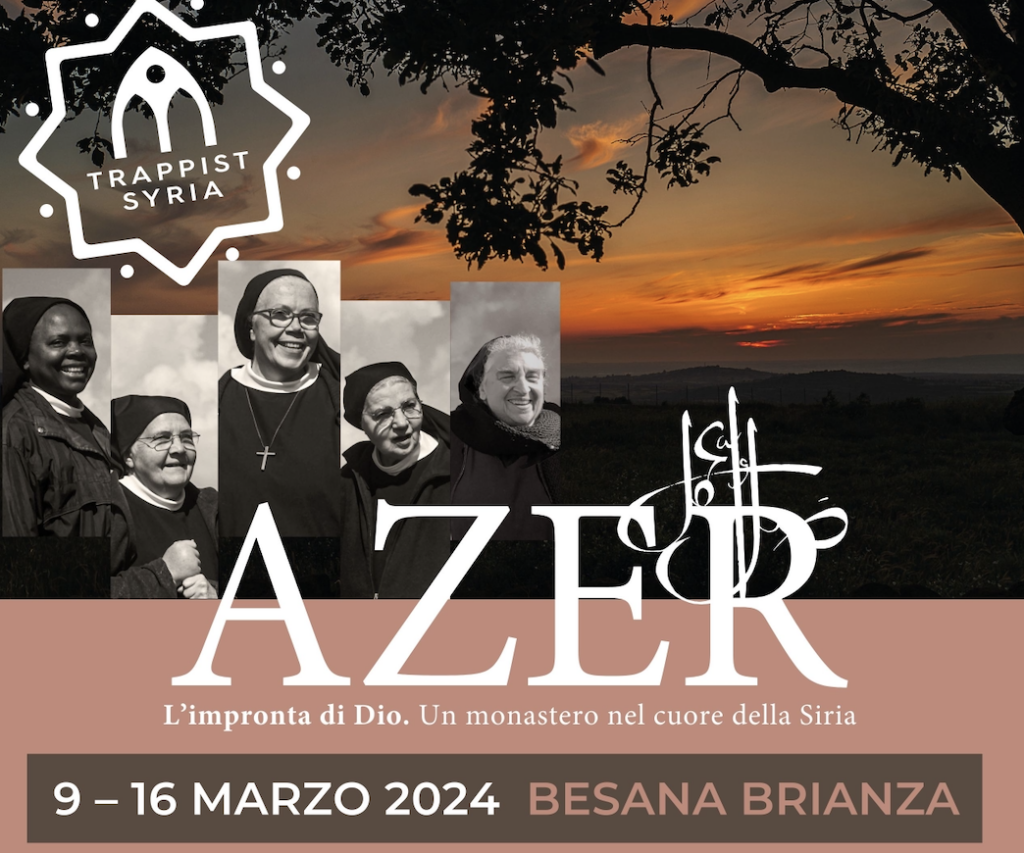
“A Monastery in the Heart of Syria,” the traveling exhibition organized by the Meeting for Friendship Among Peoples, scheduled at the Don Carlo San Martino Institute from March 9 to 16 (daily from 10 AM to 1 PM and from 3 PM to 7 PM; opening on March 9 at 3:30 PM). Videos, interviews, and photographs displayed at the event, organized by the Pio Istituto pei Figli della Provvidenza, the Equestrian Order of the Holy Sepulchre of Jerusalem, and the Pastoral Community of Santa Caterina di Besana, sponsored by the Municipality of Besana in Brianza, tell the extraordinary life of some Trappist nuns from the monastery of Azer, in Syria, on the border with Northern Lebanon. Their life is marked by the courage to witness love and hospitality.
A commitment that has spread hope since March 14, 2005, the day when Marta, Marita, Mariangela, and Adriana arrived in Aleppo from Valserena (Pisa) in response to an appeal: the Abbot General asked them to carry on the legacy of the seven Trappist monks after the events that occurred in Tibhirine, Algeria. The four champions departed without hesitation, placing themselves at the service of a great design. Thus, three years later, the first miracle came to pass: on March 26, 2008, the Foundation cross of the Beata Maria Fons Pacis monastery was placed in Azer, in the province of Homs. A rural area with a largely Muslim population. Two Christian villages, with just under five hundred souls.
Day after day, the tireless nuns build a reality of peace and brotherhood with the local population, which now considers the monastery a point of reference in daily life. Nothing stops them. Not the war, which broke out in 2011 and was aggravated by geopolitical tensions whose meaning will never be understood. Not the cholera epidemic of September 2022. Nor the earthquake of February 2023. A terrible natural event that caused over 8,000 victims, striking a region already at the end of its strength.
Day after day, Marta, Marita, Mariangela, and Adriana make a choice: to strengthen their vocation to serve others. That is why, even when war screamed hatred, to those who urged them to seek a safe place they responded that they belonged to Syria. That they were part of a history, of a destiny perhaps incomprehensible to human eyes, but directed toward an Other meaning, decipherable only through the eyes of charity. One stone at a time, the nuns have built a place of Peace, always ready to welcome and open to sharing with others, whatever Faith they belong to. In prayer and work, support for the local community never fails. One can almost picture the Muslim baker who brings a little bread to the monastery. Or the Shiite mothers who timidly ask for a blessing for their children. Or, again, the soldier, busy rummaging through the pockets of a crumpled and dusty uniform to offer a candy or a peanut to the nuns. One can almost hear the young soldier. Discouraged, hands hanging at his sides, after admiring the roses growing in the monastery garden, he asks: “Why do you plant flowers in the midst of war?” In the distance, a mortar blast.
Then, silence. “Christ never promised to solve our problems, nor to eliminate poverty and illness, but He told us that it is possible to pass through all this as He did,” the words of Sister Marta. “We too can do it, today, in a historical moment—not only for Syria—in which the struggle between Good and Evil appears evident, believing that the Holy Spirit works, is present, and makes us experience that there is never only darkness. Planting, building, caring for life, giving reason for the present and the future, makes sense even and especially in time of war.”
The gaze is lost on yellow-violet clouds. The rosy-fingered dawn paints the sky with hope.